
- Written by
- Paul, Founder
- Published
- June 2, 2026
- Reading time
- 6 min
- Written for
- Homeowners and builders
It is a strange thing to admit in a house where every other system is exceptional, and it is almost never bad luck. Large homes are actively hostile to wireless signal, and most are equipped with hardware designed for an apartment.
The house is the problem
Wireless signal is absorbed and reflected by exactly the materials fine homes are built from. Stone and brick attenuate heavily. Plaster over metal lath behaves close to a shield. Steel framing, structural steel, and radiant floor heating all interfere. Low-E glass, specified for energy performance on almost every quality build, has a metallic coating that reflects wireless signal, which is why coverage often stops dead at the terrace doors.
Add distance. A signal that comfortably crosses a 1,800 square foot house has a very different job in a 9,000 square foot one arranged over three floors and a detached pool house.
Why mesh systems disappoint here
Consumer mesh systems are genuinely good products, and they solve a real problem in ordinary houses. Their weakness in large homes is that the units talk to each other wirelessly, through the same stone, plaster, and steel that caused the problem in the first place. Each hop costs throughput, and by the third node the connection is often worse than no node at all.
The fix is not a better mesh. It is cable.
What a designed network looks like
It starts on the drawings. Access point locations are planned against the floor plans and the wall construction, so coverage is engineered rather than hoped for, including the places people forget, like the terrace, the garage, the dock, and the far end of the garden.
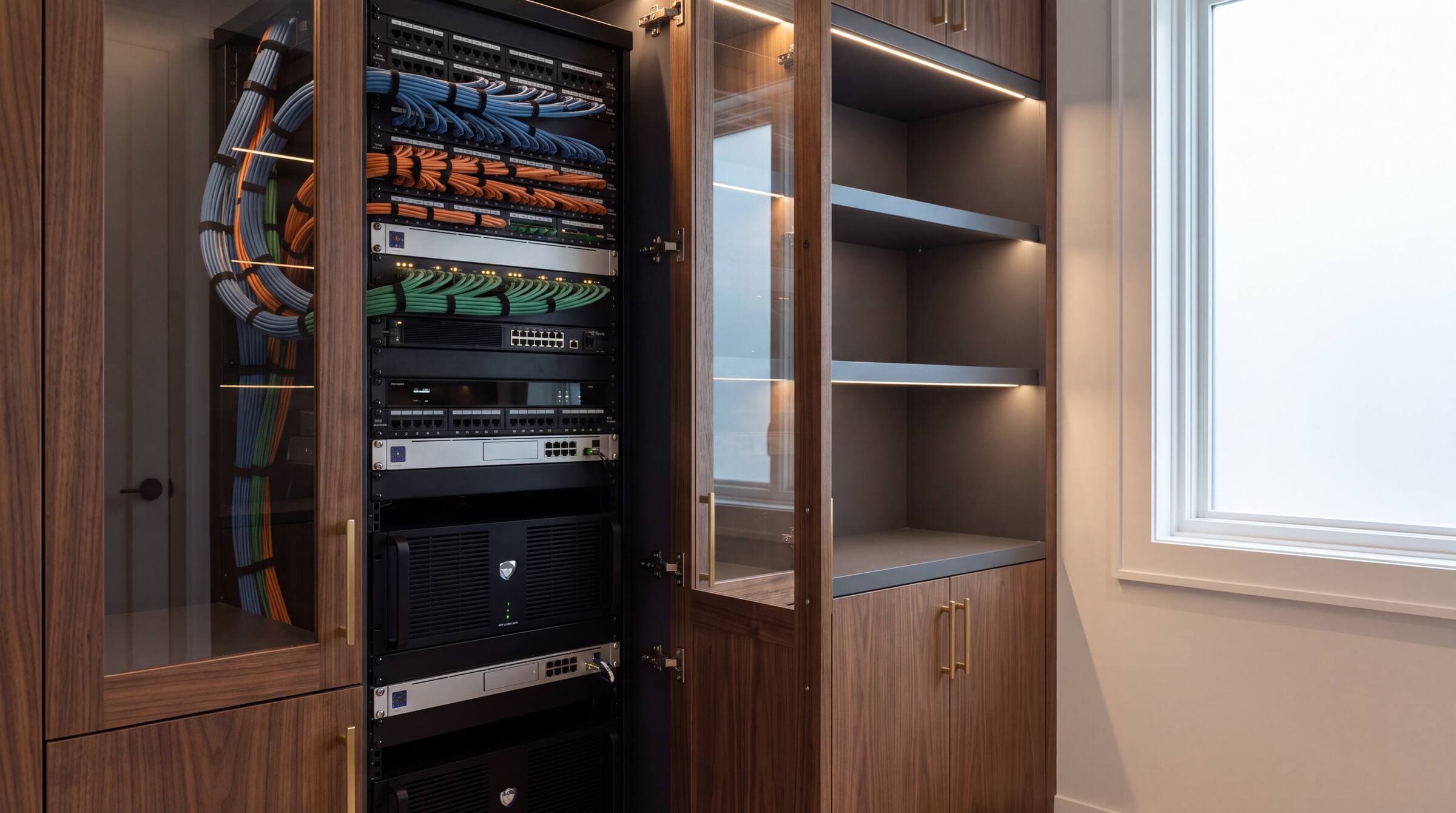
Every access point is hardwired back to a central location. This is the whole difference: each one gets full bandwidth instead of relaying through its neighbors.
Switching is managed, so faults are visible. Networks are segmented, so cameras, control systems, family devices, and guests are isolated from one another, which matters a great deal when door locks and cameras are on the network. And the equipment lives somewhere ventilated and serviceable, on protected power.
If the house is already finished
There is usually more room to maneuver than people expect. Existing coaxial or telephone runs can sometimes be repurposed for network backhaul. Attics, basements, and crawl spaces often provide routes to the locations that matter most. And a smaller number of well-placed, properly configured access points frequently outperforms a larger number scattered on guesswork.
A survey is the honest starting point. Until someone has measured the actual signal in the actual rooms, any recommendation is a guess.
The part worth remembering
Every other system in a connected home, control, streaming, cameras, entry, climate, depends on the network. It is the least visible thing in the house and the one most likely to determine whether the rest of it feels effortless or exasperating.
It is also the cheapest thing to get right during construction, and among the most disruptive to fix afterwards.